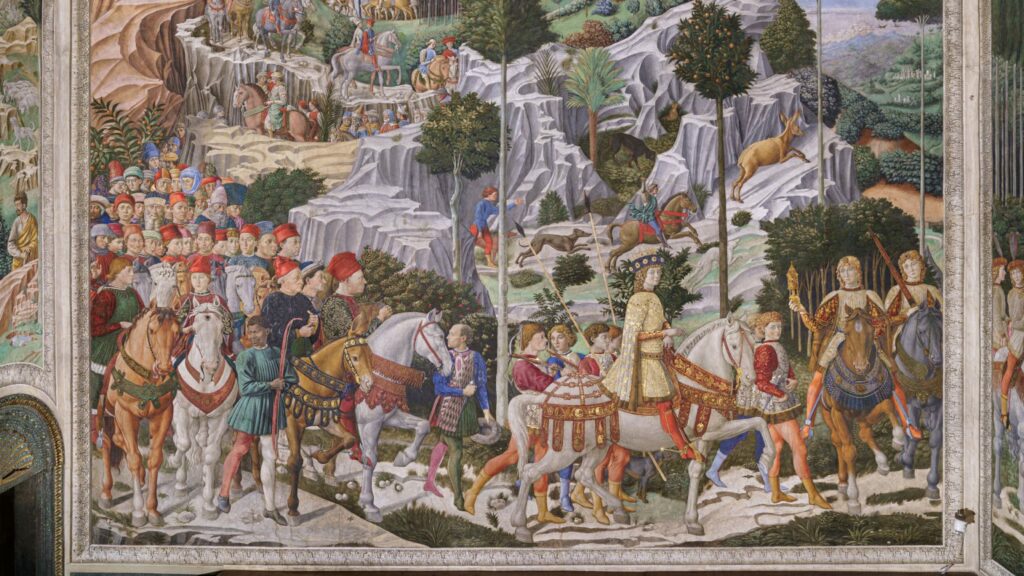
The Medici Palace in Florence was the only private building in Florence to have its own chapel. Public buildings like the Signoria (Palazzo Vecchio) or the Bargello could have chapels, which were used by the judges to pray before reading their sentences, but they usually depicted simple scenes with few figures and with a straightforward civic and religious message. This is clearly not the case with the Medici family’s own private chapel!
This treasure-chamber was built less for devotion than celebration, power and even transcendence. Not only were rare and expensive pigments, such as red lacquer, ultramarine blue and Russian malachite used, but a complex imagery was put in place to glorify the Medici family! In other words, this veritable chamber of wonders was the pride and joy of the most prominent banking family in Renaissance Europe.
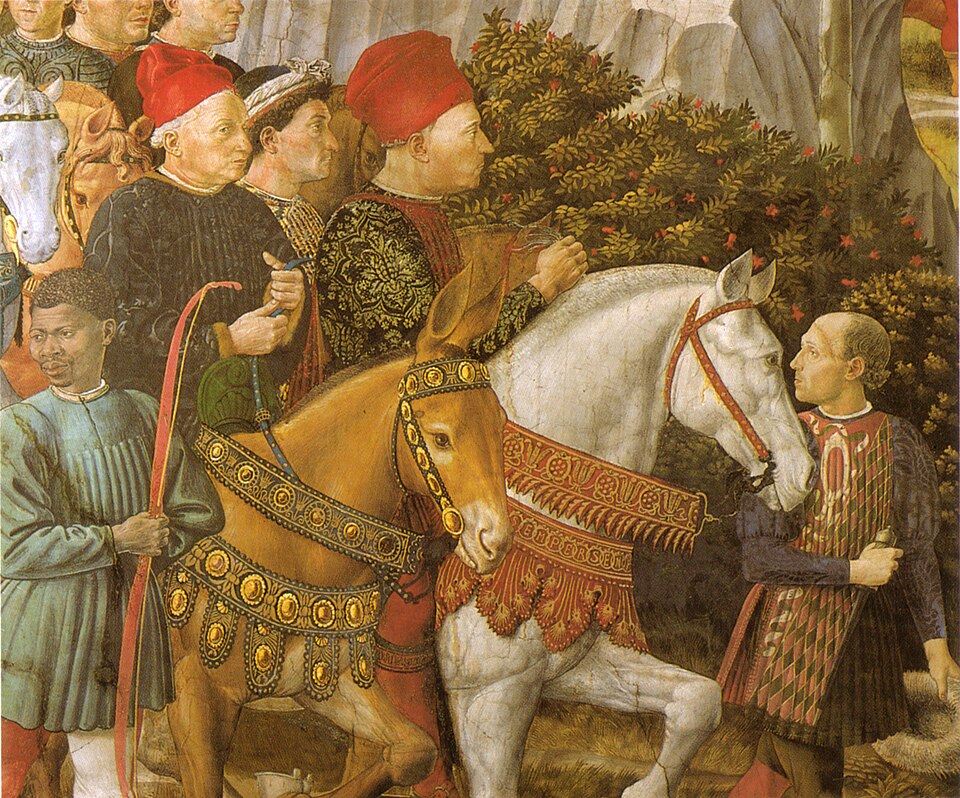
Cosimo the Elder riding a brown donkey and his son, Piero the Gouty, on a white horse (South Wall)
ALMOST LIKE KINGS
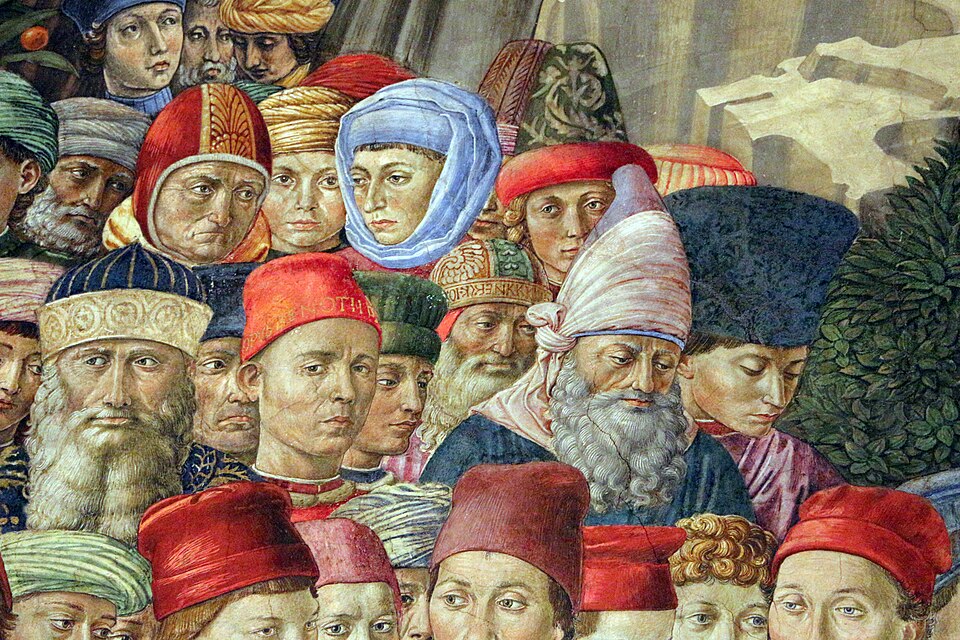
The idea or the thought of building a private chapel occurred sometime around 1449, when Cosimo the Elder was still alive. However, it will be his sons, Giovanni and, especially, Piero the Gouty who will carry on the work. Benozzo Gozzoli (1420-1497), one of the greatest fresco artists in Florence and a pupil of Fra Angelico, was commissioned to paint the fresco. He worked for five years, until 1463, and he’s so proud of his achievement that he “signs” the masterpiece with a self-portait: he’s wearing an red, elegant headpiece bearing the golden inscription “Opus Benotii” ( Latin for “Work by Benozzo”).
Self-portrait of Benozzo Gozzoli with a red hat and gold letters "Opus Benotii" (South Wall)
The painting is a complex and multi-layered work embodying various celebratory motifs. First and foremost, the choice of the subject matter, the Adoration of the Magi or Three Kings, was a favorite topic among the member of the Florentine bankers. Just like the Magi themselves, the bankers of Florence wished to be shown as humble bearers of gifts to Jesus, and at the same time be perceived as “royalty”.
In this context, the Medici could be seen as “kings of kings”, because each year the family sponsored a sumptuous Magi parade held on Epiphany day (January 6). It started from San Marco – the convent whose reconstruction Cosimo the Elder had funded – and ended at the Baptistery. The whole parade would slowly proceed through via Larga (now via Cavour), the street where the Medici palace stands, in an elegant display of colors, magnificent outfits and knightly splendor.
It goes without saying that the choice of the Adoration was more than just a decorative feast for the eyes or a way to assert Christian devotion. The whole project can be interpreted as a veritable spectacle of power for the Medici themselves.
ONLY CONNECT
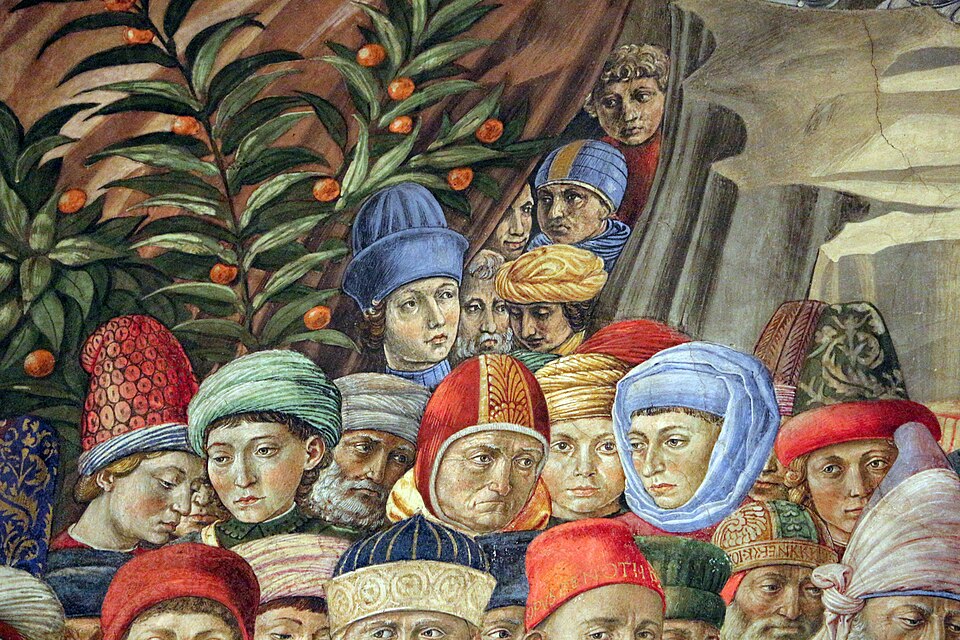
Benozzo Gozzoli, The Chapel of the Magi, Detail of Orange Trees and Pope Pius II (South Wall)
The Medici and, especially Piero the Gouty, were perfectly aware of the power of art to connect symbolism with momentous historical events. In April 1459, a young Duke of Milan, Galeazzo Maria Sforza, who was only 15 years old, arrived in Florence to pay homage to Pope Pius II and was received by the Medici in their palace. While the pope’s welcoming party was quite disappointing and “simple”, the banquet and ceremonies for the duke were beyond extraordinary. The Medici spared no expense in honoring the lord of Milan, one of the strongest allies they could bring on their side.
The idea of depicting these two powerful rulers on the walls of the chapel is not mere “lip-service” but an elaborate way to give the house of Medici a role halfway between reality and myth. By including them in the Magi narrative, the Medici are presenting themselves as the cultural nexus between secular power and religious authority.
The fact that the pope is also shown in very close proximity to the orange trees in the background might also be meaningful. Since oranges are the symbolic fruit of the Medici family (the word for “orange” or “lemon” in Latin was “mala medica” or “medicinal citrus”, and “Medici” means “medical doctors” in Italian, they used this fruit to allude to their name) and they are right behind the pope, what better way to encourage the viewer to think about a future Medici papacy?
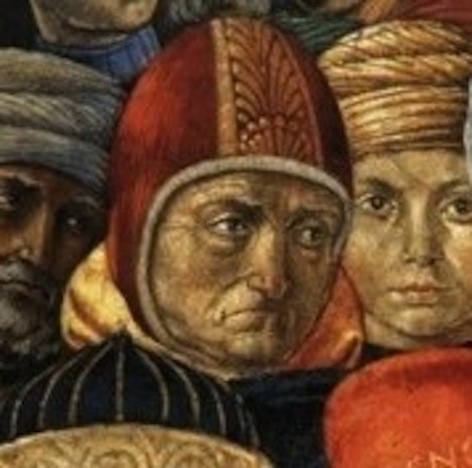
Aeneas Silvio Piccolomini, Pope Pius II (North Wall)
Galeazzo Maria Sforza, son of the Duke of Milan
THE PROPHECY
Even though they are sometimes simply labeled as the “Three Kings”, the Magi have various symbolic and even magical meanings (from “Magus”, an ancient word for “sorcerer” or “wizard”). They symbolize time (past, present and future), the three ages of mankind (youth, maturity and old age) and, in a more suggestive interpretation, the three layers of Medieval society: the clergy, the nobility and the people. As a matter of fact, each magus is associated with a gift that represents his status.
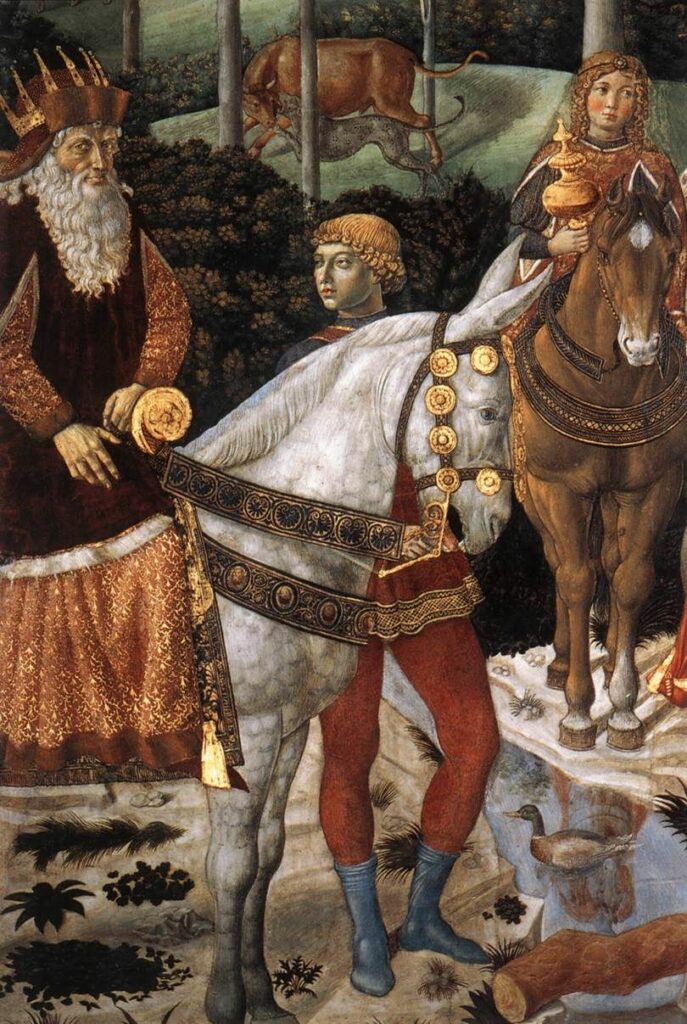
Traditionally, Melchior, the oldest magus, brings frankincense, which is associated with priests or the clergy. Gozzoli depicts him on the north wall as an elderly patriarch riding a white horse. His page is holding a beautiful golden amphora containing the aromatic resin.
Joseph II as Melchior, the oldest magus (North Wall)
Art historians have connected Melchior to Joseph II, High Priest of Constantinople. He led the Eastern Roman Church delegation to Florence during the Florence Ecumenical Council and died there in 1439.
Considering the situation of with the Medici at this point, this figure could be identified with Cosimo the Elder, the oldest living member of the family. Just like the frankincense he is bringing, his quasi-divine status was unquestionable in the history of the family!
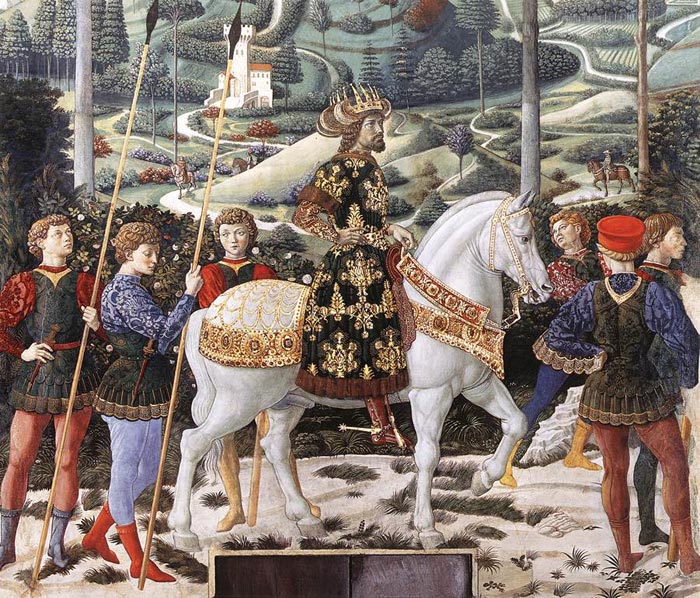
The next magus is Balthasar, the middle-aged magus of Arabian origin who brings gold. The painter depicts him as an Oriental lord, elegantly dress in moorish attire and with distinctive Oriental features. Even his horse is decorated with fine straps, intricately woven into a web of gold fabric.
John VII, Emperor of Constantinople, as Balthasar, the middle-aged Magus
In this Medici fantasy, Balthasar is associated with John VII, Emperor of Constantinople, who was in Florence during the Council in 1439, stunning everyone with his entourage of Eastern intellectuals, princes and handsome pages. The allusion to the Emperor of Constantinople is particularly impressive if the we connect the figure to Piero the Gouty, possible the most “princely” heir of the Medici family. Just like Balthasar, Piero loved riding horses, superb clothes and collecting precious art objects. Benozzo is very clear in presenting this magus as the most “royal” of the three kings.
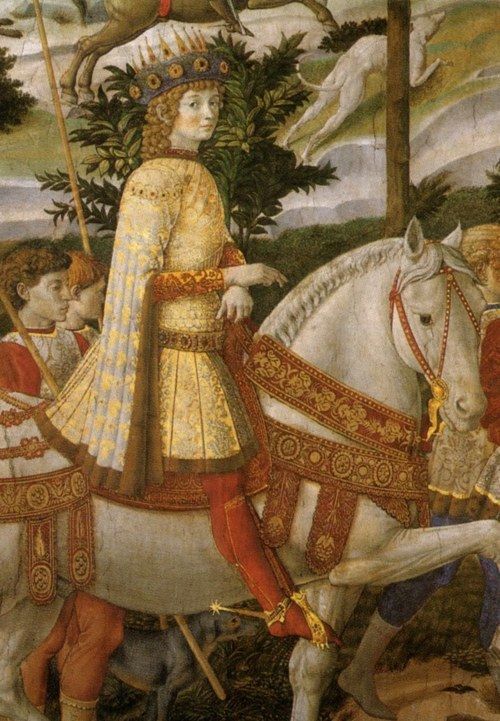
The last scene is dedicated to the youngest magus, Caspar, leading the wonderful entourage we briefly introduced before. He is undoubtedly the most prominent magus of the three not just because his scene is the most elaborate, but also because of the significance of his gift: myrrh.
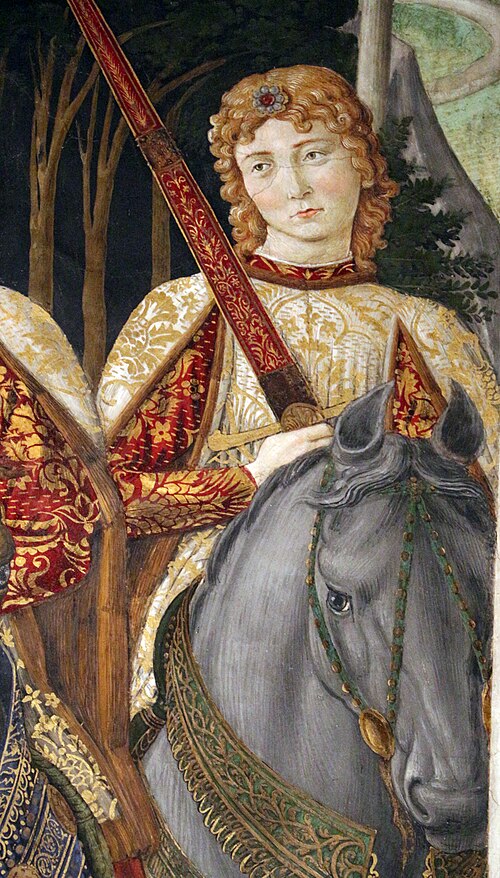
Caspar, the Young Magus (South Wall)
Myrrh is a scented ointment extracted from gum resin and in the Renaissance it was used as a preservative against corruption. Physicians (and sorcerers alike) suggested using myrrh for protection against diseases and to purify the body. Just like lemons and oranges, it was associated to healing and, therefore, perfect to represent the Medici family.
Now, Piero the Gouty’s firstborn was named Lorenzo (later known as “the Magnificent”) and he was only 14 years old at the time when Gozzoli completed his painting. However, his family hopes were already resting upon him, because his father’s health was deteriorating fast. If we associate Caspar with Lorenzo, the youngest magus and the symbolic bearer of the healing myrrh, we can understand how the family saw this young prodigy, as both the future and the healer of the whole dynasty!
His head is surrounded by a laurel bush (“Lauro”, Italian for “laurel”, is Lorenzo’s Latin name), like a glorious halo of protection. His retinue is made up of the strongest political allies a ruling family could ever get, and his powers turn him into a king, a doctor a rich merchant at the same time. This time the message is clear: Lorenzo, a man of the people, will not just take the Medici into the future, he will become a real king. The prophecy will come true and the Medic will rightfully rule over Florence, Tuscany and, possible, the whole western world!