
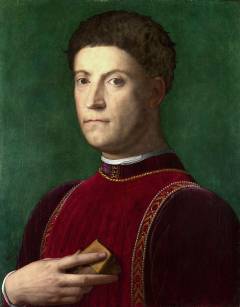
In this new tour about the Medici family, we’ll explore four exceptional and off-the-beaten sites in Renaissance Florence: Sant’Apollonia’ Last Supper, the Museum and Convent of San Marco, the Medici Palace and San Lorenzo’s Basilica. Led by an expert art historian guide, we’ll focus on the history of the Medici and their contribution to the development of the Renaissance. We’ll try to understand the reasons behind the Medici’s rise to power in the 15th century and delve into the lives of key figures, such as Cosimo the Elder, his son Piero the Gouty, and the celebrated Lorenzo the Magnificent.
Our exploration will begin with the Last Supper in Sant’Apollonia, a place far from the bustling tourist crowds that houses the world’s first Renaissance Last Supper. Painted by Andrea del Castagno in 1445, this spectacular fresco, over nine meters long and almost five meters high, is in a splendid state of preservation and is considered the prototype for all Renaissance Last Suppers, including Leonardo da Vinci’s in Milan. This innovative depiction of Christ’s Last Supper will introduce us to key concepts of the Florentine Renaissance and the history of the neighborhood where the Medici family lived.
SAN MARCO AND COSIMO THE ELDER
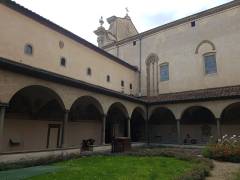
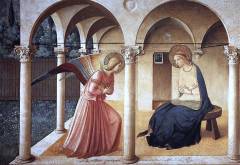
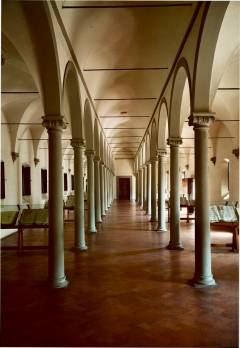
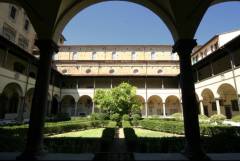
We will then continue our tour in the Museum and Convent of San Marco, which was entirely renovated by Cosimo de’ Medici “the Elder”. Michelozzo de’ Michelozzi, Cosimo’s favorite architect, built this convent in 1438 and its history is linked to important historical figures, such as the notorious Dominican friar Girolamo Savonarola, responsible for the bonfire of the vanities. Cosimo spent an enormous fortune building the common areas of the convent and the friars’ cells (and his own!) on the upper floor, and he also paid for the fresco cycle painted by the most celebrated painter of the time, Fra Angelico. We will also visit San Marco Library, the first public library in the world, with original illuminated manuscripts from the 15th century.
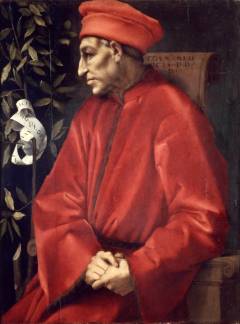
Cosimo de’ Medici—popularized by the British TV series The Medici, which was heavily criticized for its numerous historical inaccuracies—was a banker, politician, and patron of the arts among the most influential figures in Renaissance society. His shrewd and entrepreneurial personality allowed him to rise through the social ranks of 15th-century Florence, while simultaneously lurking in the shadows of politics. Victim of conspiracies and forced exile, Cosimo quickly became the arbiter of Florentine politics thanks to astute financial strategies, a dense network of relationships with Italy’s most powerful Italian lords, and a learned patronage that included the greatest artists of the 15th century.
THE MEDICI PALACE AND PIERO THE GOUTY
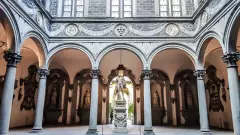
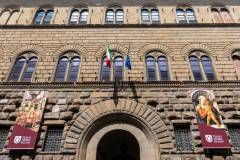
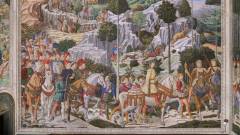
After San Marco, we’ll head to the Palazzo Medici-Riccardi, the Medici family’s first residential palace. Here, we’ll observe the distinctive rusticated stone structure and learn about the history of Renaissance architecture and how this type of mansion became the foundation for patrician palaces throughout Europe. Inside the courtyard, we’ll continue the Medici family story, focusing on the second figure, Piero, the eldest son of Cosimo, who commissioned the most interesting and, in some ways, ambiguous work of Renaissance art in this palace: the Chapel of the Magi. In this plethora of animals, plants, colors, and portraits of illustrious figures, the painter, Benozzo Gozzoli, offers a reading somewhere between realism and symbolism of the glory of the Medici family and its relationship with 15th-century Italian communal society. The fresco tells many stories and even contains a prophecy: the Medici, just like the Three Wise Men, will one day finally be recognized as the legitimate rulers of the city of Florence!
Piero, unlike his father, Cosimo, was much more attracted to the princely style of Italian courts and posed as a nobleman, despite not being part of the aristocracy. He married Lucrezia Tornabuoni, one of the most influential and cultured women in Florence, and developed a relationship of solidarity and trust with her. His health was poor, as he suffered from the gout, a disease caused by excessive consumption of animal fats (he ate too much meat!), which earned him the nickname Piero “the Gouty.” However, he was a keen art collector and a lover of “small works,” such as antique cameos, some of which are reproduced on a large scale in the courtyard of the Palazzo.
SAN LORENZO AND LORENZO THE MAGNIFICENT
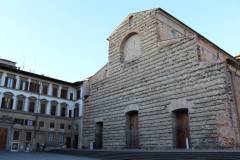
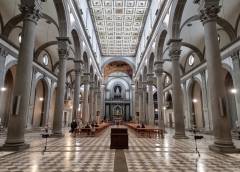
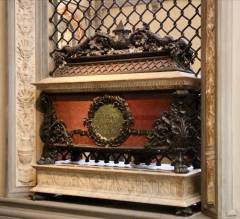
Finally, our tour will end in the Basilica of San Lorenzo, the first entirely Renaissance basilica in the world. This is the burial place of both the parents of Cosimo the Elder, Giovanni di Bicci and Piccarda Bueri, and Piero the Gouty, father of Lorenzo the Magnificent. Here, we will have the opportunity to discuss the most famous and controversial figure in the history of the Medici family, Lorenzo. He commissioned Andrea del Verrocchio, Leonardo da Vinci’s teacher, to create the bronze sarcophagus where his father lies. This work is certainly one of the rarest examples of Renaissance goldsmithing, sculpture, and architecture found in Europe.
Lorenzo didn’t have the personality of a banker, but his flamboyant character and outstanding education made him look like the perfect “humanist prince” of Florence. He loved hunting and writing poetry, as well as receiving guests in his villas, and he developed a circle of intellectuals around him called the “Neoplatonists”, whose philosophy can be considered as the foundation of the Renaissance. Being the de facto ruler of Florence also had its downsides and envy was always round the corner! He and his brother Giuliano were the victims of the famous Pazzi Conspiracy. However, while his poor brother was stabbed to death, Lorenzo miraculously survived and came out stronger than ever. His nickname “Il Magnifico” says it all!
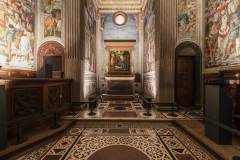
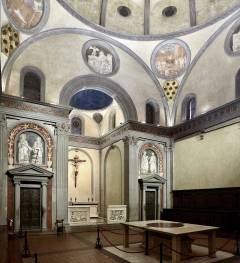
Inside the basilica, we’ll observe works by Michelangelo, whom Lorenzo had hosted in his home after discovering his talent and establishing his success as a sculptor! We’ll tell you about Donatello‘s art through his two bronze pulpits, which have been fully restored after a lengthy restoration. Above all, we’ll visit the Old Sacristy, an absolute masterpiece by the renowned artist Filippo Brunelleschi, the architect of the Duomo’s dome. We’ll tell you about the perspective and purity of his Renaissance style, but also about his surly temper, which often erupted into fits of rage, especially with poor Donatello, whom he believed had ruined his sacristy by decorating it too much with his terracotta medallions!


